
Credwiser
Loading your money guide
By Deepak S. • Co-founder, Credwiser
Figures checked against the issuer's official MITC • Last verified 2026-11-03 • How we score
Published 2026-11-03 · Updated 2026-11-22
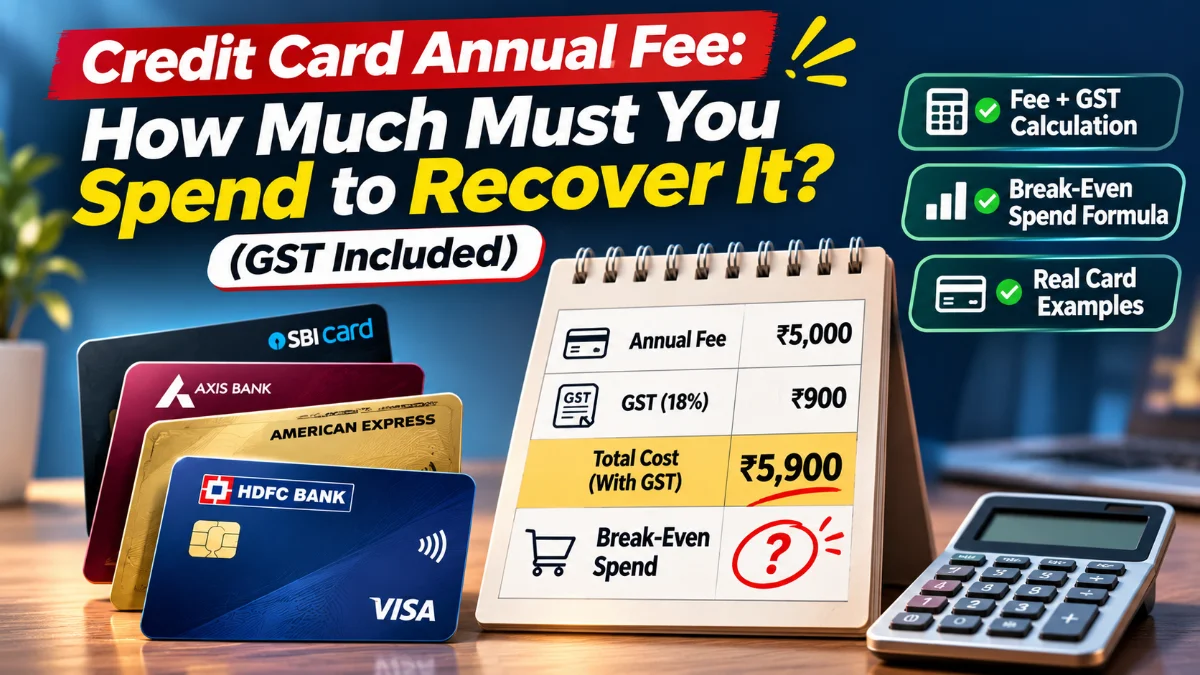
Before anything else, here is the maths this whole article runs on. GST at 18% sits on top of every card fee in India, so the fee in the ad is never the fee on your bill.
| Annual fee in the ad | GST at 18% | What you actually pay | Spend needed at 1% rewards | Spend needed at 2% rewards | Spend needed at 5% rewards |
|---|---|---|---|---|---|
| ₹1,000 | ₹180 | ₹1,180 | ₹1,18,000 | ₹59,000 | ₹23,600 |
| ₹5,000 | ₹900 | ₹5,900 | ₹5,90,000 | ₹2,95,000 | ₹1,18,000 |
Read the table this way: if your card truly costs ₹1,180 a year and your real reward rate is 2%, you must spend ₹59,000 in the year just to break even. Below that, the card is costing you money. The rest of this article shows how to find your own numbers.
Most people look at a card fee and think, "Only ₹1,000 a year, that's nothing." But the fee on your bill is never just the fee. GST sits on top of it. Rewards are often worth less than the ads suggest. And plenty of people overspend chasing a fee waiver, which makes things worse.
What you need is one number: your real break-even spend, the amount you must spend in a year for rewards to at least cover what the card truly costs you. The maths takes about 10 minutes.
In India, 18% GST is charged on credit card fees and most related charges. So the annual fee is not your final price.
Quick examples:
This covers joining and annual fees, and other charges like late payment fees usually carry GST too. Always check the total on your statement.
Fees and figures change over time, so confirm them in your bank's latest schedule of charges / MITC.
People forget the GST part when comparing cards, which is why your maths should always start with fee plus GST, never the headline fee.
Here it is:
Break-even spend = True yearly cost ÷ Effective reward rate
The effective reward rate is what you genuinely get back on every rupee spent. It is not the big number in the ad.
| True yearly cost | At 1% rewards | At 2% rewards | At 5% rewards |
|---|---|---|---|
| ₹1,180 | ₹1,18,000 spend needed | ₹59,000 spend needed | ₹23,600 spend needed |
| ₹5,900 | ₹5,90,000 spend needed | ₹2,95,000 spend needed | ₹1,18,000 spend needed |
See the gap? A high-fee card demands either very high spending or a very high reward rate. If your normal spending is modest, the card may never break even, no matter how premium it looks.
You can compare cards side by side on the Compare page to see fees and benefits in one place.
Banks love saying "earn 4 points per ₹100" or "get 5% cashback." Sounds great. But the real value depends on what a point is worth when you finally redeem it.
Say you earn 4 points per ₹100, and each point is worth only 25 paise at redemption. That's 4 × ₹0.25 = ₹1 back per ₹100. Just 1%.
If a point is worth 50 paise, you're at 2%. Transfer points to an airline or hotel partner at ₹1 per point and you could touch 4%, but that needs effort, planning, and seats or rooms actually available on your dates.
Plenty of spends earn less, too. Fuel, rent, wallet loads and insurance may earn zero or low points on many cards. Monthly caps nibble at the rate too; cross the cap and your earning drops.
So skip the headline rate. Work out your real average. Pull up your last 3 to 6 statements, see how many points you earned and what you actually got for them, and use that number.
The joining fee is charged in year one. The annual fee comes every year after that. Sometimes they're the same amount; sometimes joining is free and the annual fee quietly starts in year two.
Year one can look deceptively good because of a welcome bonus. You pay ₹1,180, get a voucher worth ₹1,000, and feel like you've won. You haven't, quite. You're still ₹180 behind unless that voucher buys something you truly needed.
From year two, the welcome bonus is gone, and the break-even test really matters. Lots of people keep paying out of pure habit. Don't. Test the card every year.
Watch out for "free first year" cards too; the real cost starts later. Mark the fee date in your calendar.
Many cards say, "Annual fee waived if you spend ₹2 lakh in a year." Sounds helpful. It can be a trap.
Suppose your natural spend is ₹1.6 lakh and the target is ₹2 lakh. The temptation is to spend ₹40,000 extra to "save" the fee.
Run the maths first. The fee is ₹1,000 plus GST, so ₹1,180. You spend ₹40,000 extra on things you didn't need. Even at a healthy 2% reward rate, you get ₹800 back. You spent forty thousand to save eleven hundred and eighty. That's not a saving. That's just extra shopping wearing a costume.
A waiver makes sense only when your natural spend is already close to the target. If you're ₹5,000 or ₹10,000 short and have a genuine purchase planned anyway, go for it. If you're far away, you're usually better off paying the fee, closing the card, or asking the bank for a retention offer.
Also read which spends count towards the waiver; some banks exclude rent, fuel or wallet loads. Don't assume every rupee moves you closer. If your card has a waiver target, the Fee Waiver Tracker shows your shortfall and the monthly pace you need before your card anniversary.
A paid card isn't automatically a bad card. Sometimes the value is real and easy to use.
Lounge access: Fly often and lounge visits genuinely save money and stress. But be honest with yourself. One flight a year won't justify a ₹5,900 true cost.
Milestone vouchers: Vouchers count only if you redeem them before expiry, on things you wanted anyway. An expired voucher is worth exactly zero.
Higher rewards on your top spends: If a card pays well on bills, groceries or online shopping and that's where your money actually goes, it can out-earn a free card by a wide margin.
Travel benefits: Flight tickets, hotel nights and good transfer partners can beat the fee comfortably, but only if you actually redeem them well.
Never pay for benefits you keep planning to use "someday."
Not sure your card is pulling its weight? Try the Card Roast tool for a quick reality check, or browse your options on the Cards page.
Do this once a year for every card you hold. Ten minutes, that's all.
Step 1: Find your true cost. Check your statement for the annual fee plus GST. Write down the total.
Step 2: Find your real reward rate. Look at last year's points and what you redeemed them for. Earned ₹2,000 of value on ₹2 lakh of spend? Your rate is 1%.
Step 3: Calculate break-even. True cost divided by reward rate. Compare the answer with what you actually spend.
Step 4: Check benefits used. Did you enter a lounge? Did vouchers expire unused? Count only what you truly used.
Step 5: Decide. Rewards plus used benefits clearly above the true cost? Keep the card. If not, switch to a free card, ask for a waiver, or close it before the next fee date.
One caution: think twice before closing your oldest card, since it affects the length of your credit history. If needed, ask the bank to move you to a free version instead.
Quick example: Fee is ₹2,000. With GST, you pay ₹2,360. Last year you spent ₹1,80,000 and earned rewards worth ₹2,700, a 1.5% rate. Break-even is ₹2,360 ÷ 1.5% = ₹1,57,333. You crossed it, but only gained ₹340 extra, and one voucher expired in a drawer. A decent free card might have given you the same benefit with zero fee stress.
And if a card charges no annual fee at all, read the hidden charges on lifetime free cards before assuming it costs nothing to keep.
### Do I have to pay GST on the joining fee also? Yes. In India, 18% GST is generally applied on joining fees and annual fees. If a card shows a ₹1,000 fee, your bill will often show ₹1,180. Always check your statement and your bank's schedule of charges.
### If my fee is waived, do I still pay GST? If the bank fully waives the fee before charging it, there is usually no fee and no GST on that fee. Rules differ by bank. Check your statement. If a fee and GST are charged and then reversed, both reversals should show clearly.
### Is it bad to close a paid card I do not use? Paying a fee every year for a card you do not use is wasteful. It is better to switch to a free card or close it. Pay all dues first and use your points before closing, as points often expire when the card is closed.
### Can I ask my bank to waive the fee? Yes, you can always ask. If you are a long-time customer with good spend and timely payments, the bank may offer a waiver or retention benefit. There is no promise, but it costs nothing to ask before the fee date.
See Credwiser first on Google
Add Credwiser as a preferred source and our card guides and explainers will show up more often in your Google Search and Top Stories.
Add as a preferred source on GoogleWas this page helpful?